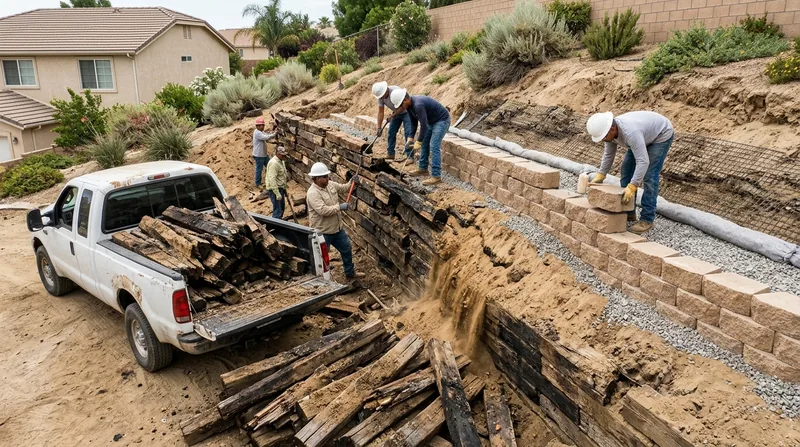




Railroad Tie Wall Replacement in Bakersfield
Bakersfield sits on the flat floor of the southern San Joaquin Valley, where sandy loam and silt soils, alkaline pockets, and hardpan layers put constant pressure on older walls. Many homes in Westchester, the southwest ranch tracts, and the newer stucco subdivisions in Seven Oaks and Riverlakes still have railroad tie walls built in the 1970s and 1980s. Those creosote-treated ties are now rotting, sagging, and leaching into the soil. Railroad Tie Wall Replacement in Bakersfield means pulling out the old ties, hauling them away, fixing the drainage, and rebuilding with segmental block, concrete, or natural stone that will hold up in this climate. If your wall is already leaning, start with leaning and collapsed wall repair before the failure gets worse. We handle the full replacement, from demolition to the final compacted backfill.
Why Railroad Tie Walls Fail in Bakersfield's Soil and Heat
Railroad ties were cheap and fast in the 1970s, but they were never designed to last 40 years in a place with blazing dry summers, rare but heavy winter storms, and constant lawn irrigation. The creosote breaks down, the wood checks and splits, and the sandy backfill behind the wall saturates every time the sprinklers run. Once the ties rot through, the wall bulges, leans, and eventually drops its face. In the northeast, homes along Panorama Drive sit on steep, eroding bluffs above the Kern River, and a failed tie wall there can send soil straight down the slope.
- Creosote-treated ties rot from the inside out, so the wall looks fine until it suddenly leans or collapses.
- Clogged weep holes trap water behind the wall, which saturates the sandy backfill and adds hydrostatic pressure.
- Alkaline soil and hardpan pockets hold water in place instead of letting it drain away.
- Winter storms in the valley can dump enough rain in a few days to wash out a bluff slope behind an old tie wall.
- Constant lawn irrigation keeps the soil behind the wall wet year-round, which speeds up rot and settlement.
If you see gaps between the ties, a lean toward the street, or soil pushing through the face, the wall is already past the point where patching helps.
Key info: A 1980s tie wall in a Riverlakes backyard often looks solid from the patio side but is hollow and rotten behind the face. We probe the ties and check the backfill before we quote a replacement, because a wall that is only leaning can sometimes be rebuilt cheaper than one that has already dropped.
For local permit thresholds and setback rules, check with the City of Bakersfield Building Department at bakersfieldcity.us before you plan a wall above roughly 4 feet or one that supports a driveway or structure.
How We Replace a Railroad Tie Wall in Bakersfield
We start by walking the wall with you and checking what is behind it. Then we tear out the old ties, haul them off, and rebuild the drainage before we set a single new block. The goal is a wall that sheds water instead of holding it, because trapped water is what killed the old tie wall in the first place.
- We remove the old ties and any rotten backing, then haul the creosote-treated wood to an approved disposal site.
- We dig out the old backfill and inspect the soil, the footing, and the slope behind the wall.
- We install new gravel backfill, filter fabric, and a perforated drain pipe that ties into a safe outlet.
- We build the new wall in segmental block, poured concrete, or natural stone, set on a compacted base.
- We compact the backfill in lifts and check the wall for plumb and alignment before we finish.
- We clean the site, haul off the debris, and walk the finished wall with you.
Every replacement gets a drainage plan, because a new wall with the old drainage problem will fail the same way in ten years.
Key info: On a Panorama Drive bluff lot, we replaced a 60-foot tie wall that had leaned toward the river after a winter storm. The new wall went in as segmental block with a gravel drain and a solid outlet, and we stabilized the slope above it so the next storm would not undercut the footing.
If the slope behind the wall is already moving, pair the replacement with slope stabilization and erosion control so the new wall is not fighting a losing battle.
Replacement Approaches We Use in Bakersfield
Not every tie wall should be replaced with the same material. A short garden wall in Westchester and a tall bluff wall above the Kern River need different answers, and the right choice depends on height, soil, access, and how much water the wall has to handle.
| Approach | Description | Best for |
|---|---|---|
| Segmental block replacement | Old ties come out, new gravel drain goes in, and we set interlocking block on a compacted base. | Most residential tie walls up to about 4 feet, including terraced yards in Seven Oaks. |
| Poured concrete replacement | We form and pour a reinforced wall with weep holes and a drain behind it. | Tall walls, driveway surcharges, and walls that need to hold heavy loads. |
| Natural stone or boulder rebuild | We rebuild the face with river rock or boulder, set against a gravel drain and filter fabric. | Sloped lots, bluff edges, and yards where the homeowner wants a natural look. |
| Timber-to-block swap with drainage upgrade | We pull the ties, fix the clogged drainage, and rebuild in block with a proper outlet. | Walls that failed mainly because water was trapped behind them. |
| Partial replacement and repair | We replace the failed section and tie it into the sound part of the wall. | Long walls where only one section has rotted or leaned. |
We will tell you which approach fits your wall after we see the soil and the slope, not before.
Railroad Tie Wall Replacement Cost in Bakersfield: What to Expect
Most replacements start around $35 per square foot of wall face, and the final number depends on height, length, access, and what we find behind the old ties. A short wall in a Westchester backyard with a gate wide enough for a wheelbarrow is a different job than a bluff wall on Panorama Drive where every block has to be carried down a slope. The old ties also have to be hauled to an approved disposal site, which adds cost on long walls.
The biggest cost drivers are wall height, total square footage, and access for equipment. Soil conditions matter too: hardpan pockets and alkaline soil can slow excavation, and a wall that needs a new drain outlet or a footing repair will run higher. Getting two or three estimates is smart, because a contractor who quotes without probing the old ties is guessing.
For a fuller breakdown of how we price walls, see our pricing page.
What to Look for When Hiring a Retaining Wall Contractor Near Bakersfield
Hiring the right contractor matters more on a tie wall replacement than on almost any other job, because the old wall is already failing and a bad rebuild will fail faster. Start with fully insured status, then ask for references on walls of similar height and soil. A contractor who cannot show you a wall they built three or four years ago in Bakersfield soil is a risk.
Get two or three written estimates, and make sure each one covers demolition, haul-away, drainage, and backfill, not just the new wall face. Check whether the wall needs a permit from the local building department, especially if it is above roughly 4 feet or supports a driveway. If you live in an HOA, ask about approval before work starts. And if the wall sits near a protected tree, confirm the setback rules before anyone digs.
To set up a free estimate, reach us through our contact page.
Railroad Tie Wall Replacement Near Me: What Bakersfield Homeowners Should Know
If you are searching for railroad tie wall replacement near me, you are probably looking at a wall that has already leaned or started to drop. The most common call we get is a 1970s or 1980s tie wall in a southwest ranch tract that has been irrigated for decades and is now rotten at the base. The second most common is a bluff wall above the Kern River that took a hit in a winter storm.
Do not wait for the wall to collapse. A leaning tie wall can often be replaced before it drops, which saves you the cost of rebuilding a slope and a footing. Call us at (661) 387-2265 and we will look at it, probe the ties, and tell you what it needs.
Railroad Tie Wall Replacement in Bakersfield: Pricing Guide
| Service | Price | Details |
|---|---|---|
| Standard railroad tie wall replacement | Starting at $35/sq ft | Includes tie demolition, haul-away, new gravel backfill, drain pipe, and segmental block rebuild. |
| Poured concrete replacement | Starting at $45/sq ft | Formed and reinforced wall with weep holes, drain behind it, and a compacted base. |
| Natural stone or boulder rebuild | Starting at $50/sq ft | River rock or boulder face set against filter fabric and a gravel drain for sloped lots. |
| Complex or large-scale job | On estimate | Bluff walls, tall walls, and jobs with limited access need an on-site look before pricing. |
| Travel | Included | In Bakersfield and surrounding areas, no separate call-out or mileage fee. |
| Estimate | Free | Response within 24h at (661) 387-2265, no obligation to book. |
Indicative pricing, the exact cost depends on square footage, finish, and site access. Free personalized estimate within 24h at (661) 387-2265.


