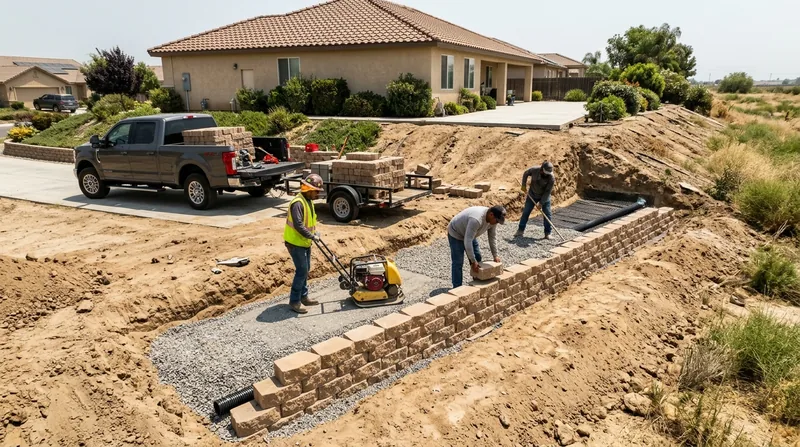




Retaining Wall Installation in Bakersfield: Built for Valley Soil and Bluff Slopes
Bakersfield sits on the flat floor of the southern San Joaquin Valley, but that flat ground hides real problems: sandy loam and silt that shift when saturated, alkaline and hardpan pockets that fight a footing, and steep eroding bluffs along Panorama Drive above the Kern River. Whether you own a 1940s bungalow in Westchester, a 1970s ranch tract in the southwest, or a newer stucco home in Seven Oaks or Riverlakes, a wall that holds is engineered, not stacked. We handle Retaining Wall Installation in Bakersfield with proper footings, gravel backfill, and drainage designed for this climate, not a generic spec sheet. If an existing wall is already bowing or cracked, start with retaining wall repair before the failure spreads.
Why Bakersfield Yards Need a Real Retaining Wall, Not a Stack of Blocks
Most wall failures we see in Bakersfield trace back to water and soil, not bad block. Constant lawn irrigation saturates sandy backfill until hydrostatic pressure pushes the face out. Clogged weep holes do the same thing faster. On the northeast bluffs, rare but heavy winter storms wash out slope toes and undercut footings. And hardpan pockets trap water against the wall instead of letting it drain.
- Sandy loam and silt backfill loses strength fast when it stays wet from irrigation.
- Alkaline soil and hardpan pockets redirect water instead of absorbing it.
- Bluff lots along Panorama Drive erode at the toe during winter storm runoff.
- Clogged weep holes and missing gravel behind the wall trap pressure against the face.
We design every new wall around drainage first, because that is what keeps it standing through a Bakersfield summer and a wet January.
Key info: A split-face CMU wall in a Riverlakes backyard failed after eight years because the original installer backfilled with native silt and skipped gravel. We rebuilt it with a gravel drainage column and a perforated footing drain, and it has held through two wet seasons.
Walls above roughly 4 feet, or walls that carry a surcharge like a driveway or structure, usually need a permit, and the City of Bakersfield building department sets the exact threshold. Check the City of Bakersfield building page before you dig.
How We Build a Retaining Wall in Bakersfield, Step by Step
Every installation starts with the dirt, not the material. We walk the slope, check where the water goes now, and confirm setbacks and property lines before anything gets ordered. Then we build in a fixed sequence so the wall has a footing, a drain, and a backfill that will not move.
- We mark the layout, verify the property line, and confirm the permit threshold with the building department.
- We excavate to stable soil, not just to grade, and cut a footing below the frost-free depth this valley actually needs.
- We set the base course level and compact it in lifts so the wall does not settle unevenly.
- We install a perforated drain at the footing, wrap it in washed gravel, and daylight it to a safe outlet.
- We backfill with clean gravel and filter fabric, never native silt, and compact every lift.
- We cap the wall, restore the grade, and leave the weep holes clear and flowing.
That sequence is why our walls hold in places where a weekend stack-and-glue job has already failed once.
Key info: On a terraced backyard in Seven Oaks, we had to cut three feet through hardpan to reach stable bearing. The original quote missed it. We caught it in the site walk, priced it before we started, and the homeowner had no surprise change order.
For sloped lots that need more than a single wall, see our slope stabilization and erosion control work, which pairs grading and drainage with the wall itself.
Retaining Wall Methods We Install in Bakersfield
The right method depends on height, load, soil, and how the wall has to look against the house. We install all four of the main systems used in this valley, and we tell you when one is wrong for your lot.
| Approach | Description | Best for |
|---|---|---|
| Poured concrete | Cast-in-place footing and stem wall with gravel backfill and footing drain. | Tall walls, driveway cuts, and walls carrying a surcharge. |
| Block and segmental | Split-face CMU or interlocking segmental block on a compacted gravel base. | Terraced gardens and tan slump-block walls that match the house. |
| Boulder and natural stone | River rock and boulder placement keyed into the slope with drainage behind. | Bluff edges and landscape walls where a natural look matters. |
| Timber | Pressure-treated timber walls for low planters and short grade changes. | Low garden walls and quick replacements of aging timber planters. |
We match the method to the load and the soil, and we tell you when a cheaper system will not survive a Bakersfield summer of irrigation.
Retaining Wall Installation Cost in Bakersfield: What to Expect
Most new retaining walls in Bakersfield start around $30 per square foot of wall face, and that figure is a starting point, not a quote. Height drives cost first: a 2-foot garden wall and a 6-foot engineered wall are not the same job. Access matters next, because a backyard in Rosedale you can reach with a skid steer prices very differently from a narrow side yard in Westchester where everything moves by hand.
Soil is the wild card here. Hardpan pockets and sandy loam can force deeper excavation and more gravel. A wall that carries a driveway or structure needs engineering, and that adds design and inspection cost. Getting two or three estimates is smart because a low bid often leaves out the drain, the gravel, or the permit.
Our full retaining wall pricing overview breaks the numbers down by material and height so you can compare bids apples to apples.
Retaining Wall Installation Near Me: How to Choose a Contractor Near Bakersfield
Hiring for a wall is mostly about verifying three things: license, insurance, and whether the contractor has built in this soil before. A wall that looks fine on day one can fail in two years if the drainage was skipped.
- Confirm the contractor is fully insured, and ask for the certificate in writing.
- Get two or three written estimates that itemize footing, drainage, and backfill.
- Ask for local references on walls of similar height and soil.
- Ask who pulls the permit, and confirm the threshold with the building department.
- Check HOA rules on wall height, material, and color before you order block.
A contractor who cannot answer the drainage question clearly is not the one to build your wall.
Ready to talk through your slope? Contact us for a free estimate and we will walk the site with you.
Retaining Wall Installation in Bakersfield: Pricing Guide
| Service | Price | Details |
|---|---|---|
| Segmental block wall, low height | Starting at $30/sq ft | Includes compacted gravel base, block, cap, and drainage; height and access move the price. |
| Split-face CMU wall | Starting at $38/sq ft | Includes footing, block, gravel backfill, and weep holes; hardpan excavation adds cost. |
| Poured concrete wall | Starting at $45/sq ft | Includes formed footing and stem wall with drain; engineering for surcharge loads adds cost. |
| Boulder and natural stone wall | Starting at $42/sq ft | Includes boulder placement keyed into slope; equipment access and stone size move the price. |
| Complex or large-scale job | On estimate | Tiered, engineered, or bluff-edge walls need an on-site look before any number is given. |
| Estimate | Free | Response within 24h at (661) 387-2265, no obligation to book. |
Indicative pricing, the exact cost depends on square footage, finish, and site access. Free personalized estimate within 24h at (661) 387-2265.


